
&emoji=&slug=kriptovijesti&button_colour=b532ed&font_colour=ffffff&font_family=Poppins&outline_colour=ffffff&coffee_colour=FFDD00)

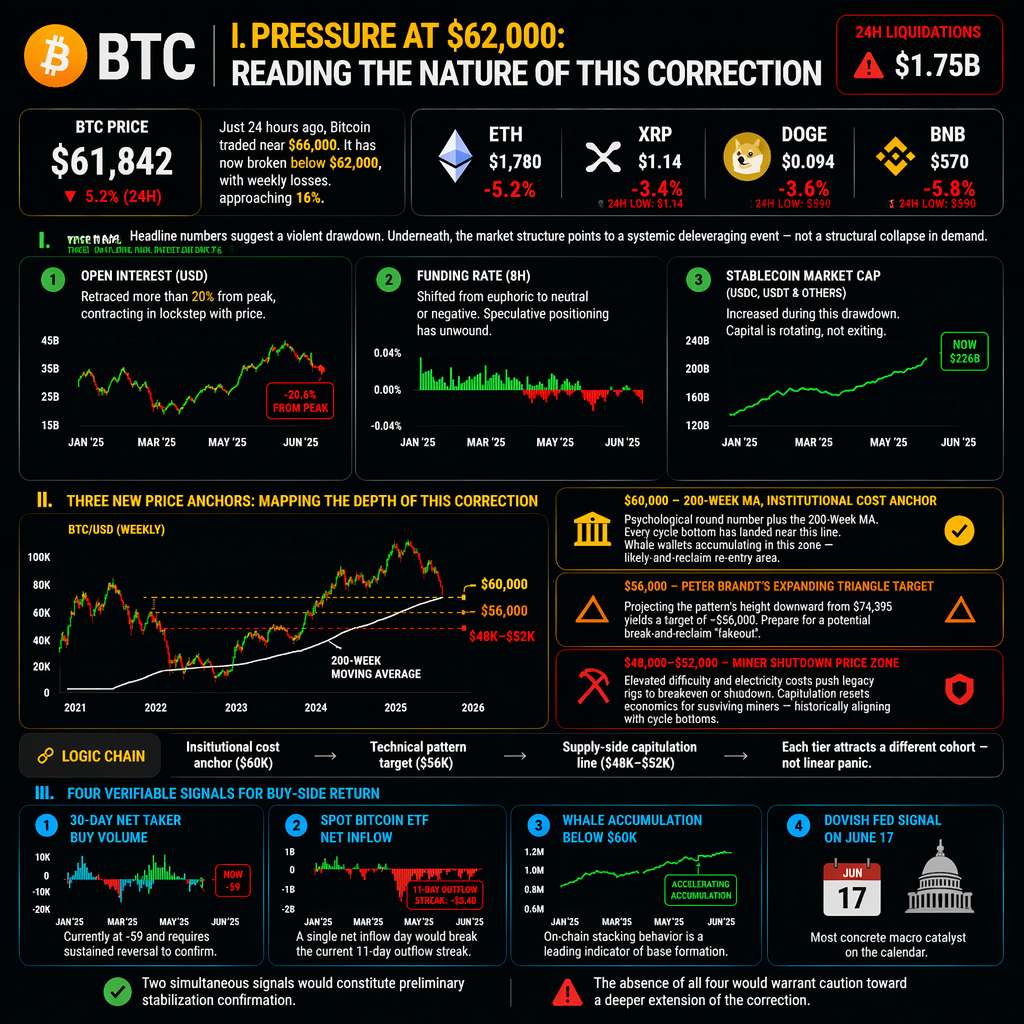

– Spot Bitcoin ETFs have logged 11 consecutive days of net outflows, totaling roughly $3.4B
– Leverage flush is approaching completion; market enters a verification window for buy-side return signals
– Key catalyst ahead: Federal Reserve interest rate decision on June 17
I. Pressure at $62,000: Reading the Nature of This Correction
While the headline numbers suggest a violent drawdown, the underlying market structure points to something more specific: a systemic deleveraging event, rather than a structural collapse in demand.
Three data points support this interpretation.
First, open interest has retraced more than 20% from its peak, contracting in lockstep with price — a clear sign that highly leveraged long positions have been systematically flushed out.
Second, funding rates have shifted from euphoric to neutral or even negative, indicating that speculative positioning has unwound.
Third, and most critically, stablecoin market capitalization (USDC, USDT and other USD-pegged crypto assets) has actually increased during this drawdown, suggesting capital is not exiting the crypto ecosystem but rather rotating defensively, awaiting a re-entry signal. This dynamic stands in sharp contrast to the wholesale capital flight observed in early 2022.

II. Three New Price Anchors: Mapping the Depth of This Correction
Building on yesterday’s support framework, three new price signals have emerged today that warrant individual examination — each adding incremental depth rather than redundancy to the original thesis:
Psychological round number plus the 200-Week MA. Every cycle bottom has landed near this line. On-chain data shows whale wallets have been accumulating in this zone — a likely institutional re-entry area. This is the continuation and confirmation of yesterday’s thesis.
Veteran chartist Peter Brandt (who called the 2018 crash) projects ~$56K from the $74,395 breakdown. Slightly below the 200-week MA — expect a possible “break-and-reclaim” fakeout.
At current difficulty and ~$0.06/kWh, older rigs turn unprofitable here, forcing hashrate offline. Miner capitulation historically marks cyclical bottoms — the market’s natural supply-side floor.
The logic chain across the three levels: institutional cost anchor ($60K) → technical pattern target ($56K) → supply-side capitulation line ($48K–$52K). Even in a downside scenario, each tier corresponds to a distinct cohort of market participants stepping in — not linear panic.
III. Four Verifiable Signals for Buy-Side Return
Rather than speculating on the exact bottom, market participants are increasingly focused on tracking confirmable inflow signals. Four indicators stand out:
1. 30-day net taker buy volume turning positive — currently at -59 and requires sustained reversal to confirm
2. A single net inflow day for spot Bitcoin ETFs — breaking the current 11-day streak of outflows totaling $3.4B
3. Accelerated whale accumulation below $60,000 — on-chain stacking behavior is a leading indicator of base formation
4. A dovish Federal Reserve signal on June 17 — currently the most concrete macro catalyst on the calendar
Two simultaneous signals would constitute preliminary stabilization confirmation. The absence of all four would warrant caution toward a deeper extension of the correction.
IV. AI Sector as Capital Sanctuary: A Cross-Asset Rotation Opportunity
Notably, while the crypto market has come under pressure, the U.S. equity AI sector has continued to print fresh highs — a clear signal of cross-asset rotation. The underlying logic is straightforward: AI Agent–era compute demand is structural and largely decoupled from the macro liquidity cycle.
From a fundamentals and institutional positioning standpoint, the following names warrant close attention:
One under-appreciated structural shift: the CPU-to-GPU ratio is migrating from 1:8 toward 1:1 in the AI Agent era — a re-rating tailwind for CPU providers that the market has yet to fully price in.

V. Strategic Framework for the Current Stage
Synthesizing the above, the prevailing institutional approach is not bottom-fishing but portfolio rebalancing based on verifiable signals:
Reduce crypto exposure while preserving a core position — observe buy-side strength near the $60,000 first line, watch for a break-and-reclaim around the $56,000 pattern target, and enforce strict risk management below the $48,000 miner shutdown zone;
Selectively increase AI infrastructure allocation — anchored by sector leaders such as NVDA and AVGO, accumulating on dips rather than chasing strength, to hedge crypto downside;
Maintain ample cash and stablecoin reserves — preserving optionality through Fed week.
VI. The Time Dimension: A Critical Risk Note
Technical analyst Peter Brandt and other market observers suggest that the genuine bottom-building window may extend into Q3-Q4 2026 — measured in months, not weeks. Investors should therefore abandon expectations of a sharp V-shaped recovery and instead adopt a multi-month capital management framework.
13 days remain until the Federal Reserve’s June 17 decision. A hawkish hold could push Bitcoin toward Brandt’s $56,000 target or the miner shutdown zone; a dovish pivot could rapidly reclaim $73,000. Regardless of direction, the structural tailwind underpinning AI infrastructure remains intact.
The real test at $62,000 is not whether the market has bottomed, but whether investors’ portfolio structures are resilient enough to navigate the cycle.







 &emoji=&slug=kriptovijesti&button_colour=b532ed&font_colour=ffffff&font_family=Comic&outline_colour=ffffff&coffee_colour=FFDD00)